Author: admin

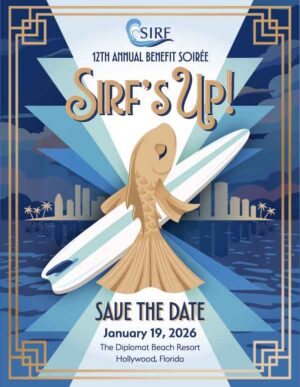
12th Annual SIRF Benefit Soiree

Save-the-date

Join Us for the 12th Annual SIRF Benefit Soiree!

The SIRF Board of Directors invites you to an elegant evening celebrating our shared commitment to the seafood industry’s future.

Monday, January 19, 2026, at The Diplomat Beach Resort Hotel — Hollywood, Florida

Kick off the night with cocktails at 7:15 p.m., followed by a plated dinner at 8:15 p.m.–Cocktail Attire

Join industry leaders, partners, and friends for an unforgettable evening of benefit gala to raise funds to support research in the seafood industry, guest speaker Dr. Norbert Kaminski, Professor and Director, Institute for Integrative Toxicology, Michigan State University

Sponsor a table to demonstrate your support to SIRF’s mission
Demonstrate your commitment to the future of the seafood industry by sponsoring a table at the 12th Annual SIRF Benefit Soiree. Your support helps fund innovative, forward-thinking research that advances our industry.

For sponsorship details, please contact Geraldine Espejo at gespejo@nfi.org or 703-752-8890.

 Special Thanks to the SIRF Board of Directors

  • Sean O’Scannlain, Fortune International — Chair & Director
  • Lisa Wallenda Picard, National Fisheries Institute — Secretary & Treasurer
  • Jim Bonnvie, Seafax — Director
  • Dan DiDonato — Director
  • Bill Dresser, Sea Port Products — Director
  • Jordan Mazzetta, Eddie M’s — Director
  • Larsen Mettler, S2G Ventures — Director
  • Russell Mentzer — Director
  • Christine Ngo, H & N Group — Director
  • Wynter Courmont, Diversified USA — Director
  • Ben Schwartz, Harbor Seafood — Director
  • Jeff Stern, CenSea — Director
  • Mike Walsh, Northwest Seafoods — Director
  • Jason Mulvihill, Lineage — Director

Save the Date: SIRF 8th Annual Benefit Soirée

The 8th Annual SIRF Benefit Soiree will take place on January 17, 2022, in Orlando, FL at Omni Orlando Resort at ChampionsGate. The evening’s featured speaker is Leo Cooperhouse, President and CEO of BlueNalu, a global leader in cell-cultured seafood that provides consumers with great tasting, healthy, safe and trusted products that support the sustainability and diversity of our ocean.

or more information on the event, contact SIRF, gespejo@nfi.org.

Bornstein Seafoods

Bornstein Seafoods Inc.

Myer A. Bornstein founded Bornstein Seafoods in 1934, during the Great Depression. It was a time when moonshiners and federal agents were battling it out over illegal booze, night baseball was being introduced to the Pacific Northwest, and you could buy fresh, skinned sole in Bellingham, WA for 15 cents per pound!

The fledgling company cut its teeth in that rough and tumble time of give and take, eager to survive and make its mark in a world of turmoil and adversity. Hard work, commitment, and slogans like “If you don’t trade with us, we both lose money!” were the order of the day.

Myer Jay Bornstein, known as “Jay” in the industry, took the helm from his father in 1980. Under Jay’s leadership the company expanded its presence throughout the West Coast — with processing capabilities and buying stations that stretch from South East Alaska through Canada, Washington, Oregon, and down to Northern California.

In 2010, Bornstein Seafoods passed leadership of the company to its third generation – Jay’s three sons Kyle, Colin and Andrew Bornstein. With Colin serving as CEO, together they plan to continue Bornstein’s growth initiatives by focusing on Quality, Productivity, Professionalism, and Teamwork with staff, fishing partners, and customers. Bornstein Seafoods remains one of the oldest corporations in the industry because of our commitment to this philosophy.

Quarter 1 2017 Newsletter

Mark D. Leslie Living Tribute Fund Continues Fundraising, SIRF Sponsors New Research in Ghana, Gorton Cup, SIRF Soirée

Quarter 4 2016 Newsletter

Mark Leslie Living Tribute Fund, 2016 SIRF Donors, DNA Research and the SIRF Soirée

SIRF Funds DNA Testing Project for Fast Identification of Fish Species

Research Could Produce Potential Check on Seafood Fraud

November 28, 2016-McLean, VA- The Board of Directors of the Seafood Industry Research Fund (SIRF) have funded research for the development of a fast, cost-effective identification of edible fish and fish products to prevent species substitution and fraud. The project will be led by Dr. J. Aquiles Sanchez, Ph.D. of the Department of Biology at Brandeis University in Waltham, Massachusetts.

The research seeks to develop a rapid means of seafood species identification using Closed-Tube DNA Bar Coding. Compared to difficult and expensive FDA DNA testing, the Closed-DNA system represents a convenient alternative that can be used with both laboratory equipment and, importantly, handheld devices. The project could benefit seafood companies, distributors, restaurants and consumers by providing a tool for protecting product from mislabeling and species substitution.

“The FDA has a strong interest in any new technologies and techniques that could potentially decrease cost and time of analysis, while increasing throughput and ease of use,” said Jonathan Deeds, Ph.D. of the FDA Office of Regulatory Science. “Methods with the potential to be field deployable are of particular interest. For public health, it is vital that both domestic and imported seafood be safe, wholesome and properly labeled.”

The research would compile a reference database of DNA “barcodes” for species at high risk of mislabeling or substitution. Suppliers, distributors and retailers could use the method of authentication to maintain the quality of their brand and retain consumer trust.

Jamie Marshall, chairman of industry watchdog group The Better Seafood Board (BSB), views the SIRF DNA project as a potentially powerful tool in combating seafood fraud.

“Industries thrive or perish on their reputations,” Marshall said. “The seafood business needs more effective resources in defending itself against the bad actors who threaten the opinions and goodwill of its consumers. I look forward to following the study and learning about the practical applications it may have for product quality and authentication.”

Established in 1964, SIRF funds research grants to colleges, universities and other institutions for research related to the seafood industry and the consumers of its products. SIRF Chairman Russ Mentzer views the newly approved study as squarely aligned with the organization’s pragmatic approach to seafood research.

“The FDA’s interest in this technology is beneficial to the seafood community,” said Mentzer. “This rigorous protocol will help establish a tested standard useable throughout the seafood supply chain, a business-based solution made possible by our excellent donor-base and scientist partners.”

###

The Seafood Industry Research Fund (SIRF) was established in 1964 to fund research grants to colleges, universities and other institutions for research related to the seafood industry and the consumers of its products. SIRF is supported entirely by voluntary contributions from individuals and companies in and related to the seafood industry.


SIRF Funds DNA Testing Project for Fast Identification of Fish Species

Research Could Produce Potential Check on Seafood Fraud

November 28, 2016-McLean, VA- The Board of Directors of the Seafood Industry Research Fund (SIRF) have funded research for the development of a fast, cost-effective identification of edible fish and fish products to prevent species substitution and fraud. The project will be led by Dr. J. Aquiles Sanchez, Ph.D. of the Department of Biology at Brandeis University in Waltham, Massachusetts.

The research seeks to develop a rapid means of seafood species identification using Closed-Tube DNA Bar Coding. Compared to difficult and expensive FDA DNA testing, the Closed-DNA system represents a convenient alternative that can be used with both laboratory equipment and, importantly, handheld devices. The project could benefit seafood companies, distributors, restaurants and consumers by providing a tool for protecting product from mislabeling and species substitution.  

“The FDA has a strong interest in any new technologies and techniques that could potentially decrease cost and time of analysis, while increasing throughput and ease of use,” said Jonathan Deeds, Ph.D. of the FDA Office of Regulatory Science. “Methods with the potential to be field deployable are of particular interest. For public health, it is vital that both domestic and imported seafood be safe, wholesome and properly labeled.”

The research would compile a reference database of DNA “barcodes” for species at high risk of mislabeling or substitution. Suppliers, distributors and retailers could use the method of authentication to maintain the quality of their brand and retain consumer trust.

Jamie Marshall, chairman of industry watchdog group The Better Seafood Board (BSB), views the SIRF DNA project as a potentially powerful tool in combating seafood fraud.

“Industries thrive or perish on their reputations,” Marshall said. “The seafood business needs more effective resources in defending itself against the bad actors who threaten the opinions and goodwill of its consumers. I look forward to following the study and learning about the practical applications it may have for product quality and authentication.”

Established in 1964, SIRF funds research grants to colleges, universities and other institutions for research related to the seafood industry and the consumers of its products. SIRF Chairman Russ Mentzer views the newly approved study as squarely aligned with the organization’s pragmatic approach to seafood research.

“The FDA’s interest in this technology is beneficial to the seafood community,” said Mentzer. “This rigorous protocol will help establish a tested standard useable throughout the seafood supply chain, a business-based solution made possible by our excellent donor-base and scientist partners.”

###

The Seafood Industry Research Fund (SIRF) was established in 1964 to fund research grants to colleges, universities and other institutions for research related to the seafood industry and the consumers of its products. SIRF is supported entirely by voluntary contributions from individuals and companies in and related to the seafood industry.