
Category: News
Meet SIRF Board Member Ben Schwartz

Meet Ben Schwartz, a shellfish aficionado, a road cyclist, a SIRF Board member and Director of Food Safety and Quality Assurance at Harbor Seafood Inc. Schwartz was confirmed to the seat in 2021, based on recommendations from the previous holder, Pete Cardone, and Schwartz’s former Quality Assurance mentor Stephen Thompson. Among the many wonderful attributes of SIRF, Schwartz favors the ability to support research and education through seafood industry funding. Schwartz enjoys being able to honor the legacy of past and present titans of the industry through living and memorial funds.
Schwartz professes the importance of education; and how vital it is to support the next generation of scientists focused on the seafood industry to benefit consumers. As a part of what he would call a “small-big” industry, Schwartz’s perspective on the seafood industry was shaped early on with his Introduction to SIRF through involvement in the National Fisheries Institute and its Future Leaders Program, which he is grateful for Harbor Seafood ownership sponsoring him for the class of 2016. The program gave him the insight to see the relationships built between the large and small players of the industry. He saw the importance of every piece of the supply chain and their focus on a common goal, providing healthy meals to people all over the world
Working with SIRF has translated directly into his daily work with Food Safety Quality Assurance (FSQA), as SIRF supports and funds different research projects related to FSQA. Schwartz travelled with Margaret Malkoski, SIRF’s scientific liaison to visit Dr. Dan Distel at the marine science center of Northeastern University, where a DNA database for commercially traded seafood was funded to help combat seafood fraud.
There are some aspects of the seafood industry that have been eye opening for Schwartz since working with SIRF. Working with the Board gave him a stronger understanding of how the industry can support research and development. The SIRF funds focus more on applied scientific and research fields, and is a side of the industry most are not as well-versed in.
The Board itself is built of all different backgrounds and works as a whole body with a variety of perspectives and voices. Bringing different views together to create one voice is of the utmost importance. Guiding such an immense industry, Schwartz takes a lot of inspiration from former SIRF Board Member and founder of Harbor Seafood Pete Cardone, whom he describes as a big proponent of detail-oriented research and charitable endeavors that helped to support the seafood industry. Schwartz’s goal is to make clear lines of communication that allow and encourage collaboration.
In 2020, the FDA launched an initiative called the “New Era of Smarter Food Safety Blueprint”. It has four main pillars: tech-enabled traceability, smarter tools and approaches for prevention and outbreak response, new business models, and retail modernization. Still working to be fully
implemented by the FDA, it can be difficult to apply new regulations for such a vast industry.
For Schwartz, these pillars are a large part of his daily routine; traceability and foodborne illness prevention are at the forefront of food safety and quality assurance. He underlines the importance of advancing technology for traceability in such a complex category.
In the same vein of technology and traceability, the future of safety in the seafood industry grows as demand heightens. Seafood has always fallen into the healthy alternative category; however, the stigma surrounding the food hasn’t left. Schwartz explains that seafood is always the scapegoat when it comes to food poisoning, not the appetizer or the drinks; it must have been the fish. The focus on food safety in the future is to provide confidence to consumers.
Working with other companies, institutions, industries, and academia, like SIRF, will allow the development of new tools to help FSQA and allow for more efficiency as well.
Learn more about SIRF Board Member Dan DiDonato
The 2024 Gorton Cup

This year marked the 30th anniversary of the Annual Gorton Cup Hockey Game. A beloved tradition, the game took place at Boston University’s Walter Brown Arena on Sunday, March 10.
The game was played in honor of longtime NFI President, the late John Connelly. His wife, Margaret Connelly, ceremoniously dropped the puck to initiate the game. The fundraiser raised $9,280 in pledged donations for the Seafood Industry Research Fund’s John P. Connelly Memorial Fund, which was established in September 2023.
The game’s final score was 7-3 with Seafood All Stars winning.
Photo credit to Adrienne Arnold.




John P. Connelly
Memorial Fund
SIRF Establishes the John P. Connelly Memorial Fund
The SIRF Board of Directors announced at its board meeting in September 2023 the establishment of the John P. Connelly Memorial Fund. John served as NFI’s president from 2003-2022. He was a fierce advocate for the men and women of the seafood community and a beloved industry leader. During extensive travels, he always found time to send hand-written postcards to friends and family.
.
Dr. Nick Ralston’s Selenium Mercury Research
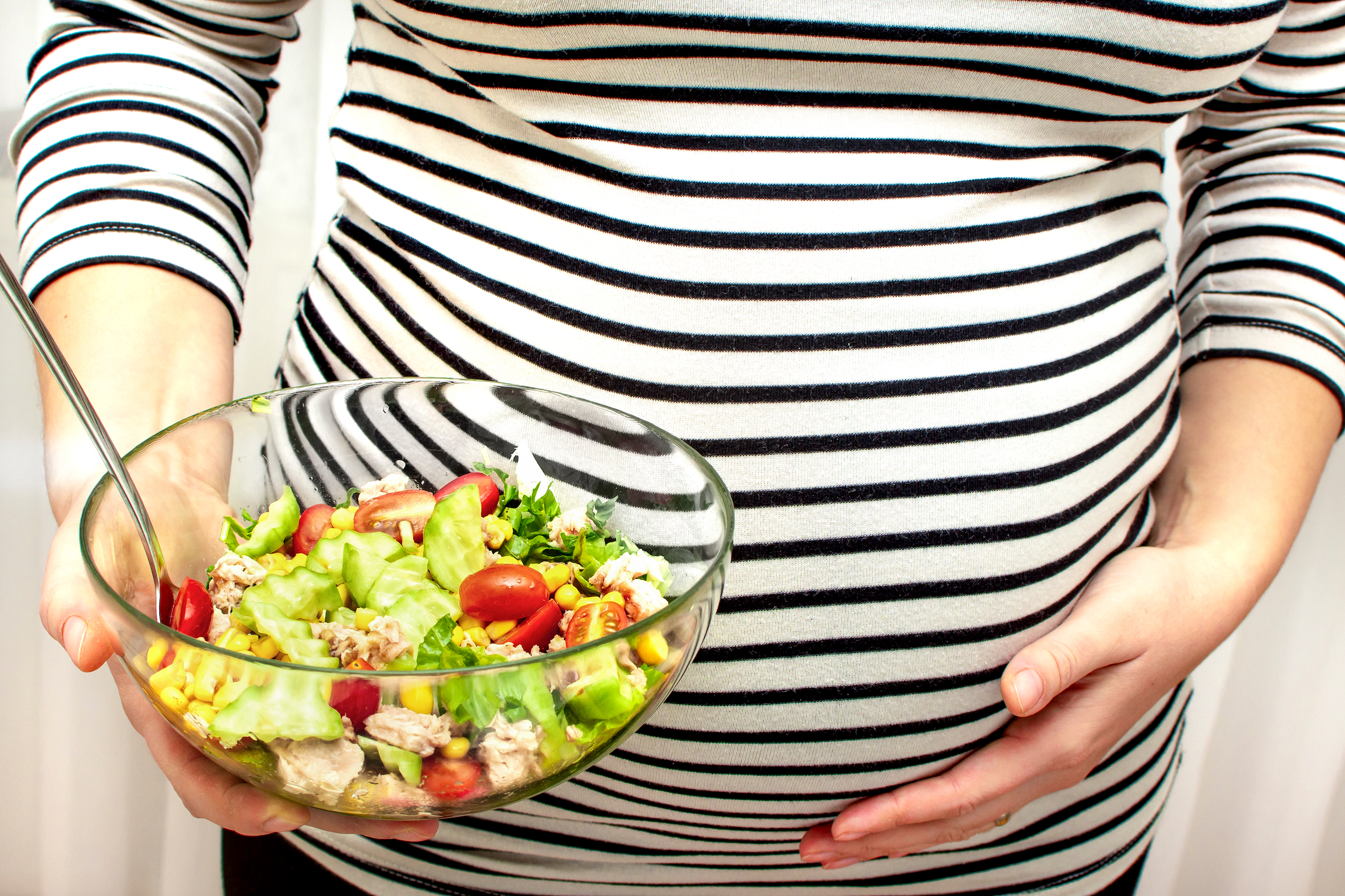
Dr. Nick Ralston, an esteemed scientist, has made significant contributions to our understanding of the relationship between mercury and selenium in seafood. With a dedicated career that spans decades, his research has revolutionized the way we perceive the impact of seafood on human health. In this blog, we explore the fascinating journey of Dr. Ralston and the pivotal role of selenium in keeping seafood safe.
Dr. Ralston’s scientific journey began with a focus on selenium nutrition research, where he studied its importance in human metabolism. Learning about the discovery of a selenium-rich protein in fish sparked his interest in the mercury-selenium interaction. This revelation marked a turning point in his career, leading him to switch his research program to study the effects of mercury on human health when bound with selenium.
Over the years, selenium has been recognized as an essential element for humans, facilitating the functioning of 25 different types of enzymes critical for various biochemical reactions in the body. It also plays a big role in protecting against oxidative damage. Ocean fish rank among the top sources of selenium, making them an important part of a healthy diet. Interestingly, the relationship between mercury and selenium in seafood acts almost like a magnetic interaction. The presence of mercury in the body can interfere with selenium metabolism, but so long as there is enough selenium available to perform its vital functions in the brain, no toxic effects arise. Dr. Ralston’s groundbreaking ocean fish study, supported by the EPA, showed that most ocean fish contain more selenium than mercury, making them safe and beneficial for consumption.
In terms of addressing common concerns about mercury consumption during pregnancy, Dr. Ralston highlights the significance of selenium’s protective role. By ensuring sufficient selenium intake through ocean fish, pregnant mothers can safely benefit from the nutritional advantages of seafood without exposing their babies to risk. Dr. Ralston also emphasizes the importance of simplifying scientific findings for policymakers and healthcare providers. By presenting the mercury-selenium relationship in simplest terms, it becomes easier to communicate the safety of seafood consumption, particularly for pregnant women. Looking ahead, Dr. Ralston envisions a positive shift in seafood consumption recommendations. With increasing awareness of the mercury-selenium dynamic, more women may be encouraged to include ocean fish in their diets during pregnancy, ensuring healthier outcomes for their children.
Dr. Nick Ralston’s journey in mercury-selenium research has taken him from the depths of scuba diving to the forefront of biomedical research. His unique perspective and mentor’s guidance have driven him to explore the molecular intricacies of mercury and selenium, uncovering their unexpected protective role in seafood. His pioneering research has redefined our understanding of the mercury-selenium relationship in seafood, shedding light on the essential role of selenium in mitigating mercury’s harmful effects. His work not only assures the safety of seafood consumption but also holds the promise of healthier generations in the future. Dr. Ralston’s dedication to bridging science and policy serves as an inspiration, urging us to continue unraveling the mysteries of nature for the betterment of human health and the environment.
The Career of Dr. Nick Ralston: Discovering the Connection Between Mercury and Selenium

The Career of Dr. Nick Ralston: Discovering the Connection Between Mercury and Selenium
Many people in the seafood industry recognize Dr. Nick Ralston as an accomplished scientist whose research has changed the way we understand the relationship between seafood and health, but how did he get there? SIRF interviewed Dr. Ralston to get more insight into his career and discoveries.
Q: Your career researching mercury and selenium has spanned decades. But, going back to the start, how did your journey begin in studying the effects of mercury on human health? How did this become your passion?
Dr. Ralston: My training in disease pathology, but my work has become so involved with ocean and freshwater fish that I am now more of an ecotoxicologist. This transition may have occurred because I love the ocean and have been a scuba diver since I was young. One of my all-time favorite summers was spent in the Florida Keys diving two to three times a day as part of a marine biology course. Although I eventually went into biomedical research and was at the Mayo Clinic for a number of years, my real love is marine biology. One of my mentors at the Mayo Clinic always said that you had to understand a disease at the molecular level in order to properly diagnose and treat it. He also felt that it was our duty to take on the problems that had the worst effects on the most people and I agreed. When I first became aware of the mercury issue, I was researching the influence of dietary selenium on inflammation. Selenium is a mineral in soil that is taken up by plants, but it has key roles in animal health. It is required to make an amino acid which is essential in proteins made by all forms of life that have complex brains. One day I came across a research paper describing a protein in fish that was unusually rich in that selenium-containing amino acid. Knowing that mercury binds extremely well with sulfur and that it binds even better with selenium, I thought, “Wow, I bet that would bind a lot of mercury. I wonder if that’s why it has so much selenium”. Recognizing how bad it would be for the brain to have its selenium become bound by mercury, my interest was aroused. Within a year I began investigating the seafood mercury issue. I initially thought ocean fish must contain more mercury than selenium, but that wasn’t the case. It took a while to learn that ocean fish hadn’t caused the mercury-related problems we all heard about, but they were being blamed. Two major studies of the problem had been done when I started looking into the issue. One examined children whose mothers ate ocean fish during pregnancy but found there were no harmful effects. Another reported mercury-related problems, but in that study the majority of the mercury the mothers had been exposed to had come from eating whale meat! Why anyone would base fish consumption advice on a study of the effects of eating whale meat was a mystery, and it is my job to study mysteries.
Q: You’ve been at the University of North Dakota for nearly two decades and currently lead research programs involving human and environmental health. With over 70 publications under your belt, can you share the vital role selenium plays in human health and where we can find it in foods?
Dr. Ralston: Selenium is a vitally important nutrient that we can’t live without. My research team started examining mercury’s effects on selenium-dependent enzymes (selenoenzymes) just over 20 years ago. However, we were not the first to notice these interactions. In 1967, selenium was shown to be extremely effective in protecting against otherwise uniformly lethal effects of mercury toxicity in rats. Since selenium’s importance was largely unknown at that time, no one understood how it could provide such complete protection. We now know that all forms of life that have complex brains express selenoenzymes in every cell of their bodies. Of the 25 selenoenzyme genes expressed in humans, over half are involved in preventing and/or reversing oxidative damage, while others perform essential functions like controlling thyroid hormones and regulating calcium levels in cells. The brain cannot survive without selenoenzyme protection against oxidative damage. Antioxidants such as vitamin C are also important, but for them to provide protection, they need selenoenzymes to continually restore them to their functional forms. Without the protection provided by selenoenzymes, brain damage would happen quickly, and death would soon follow. This is why we need selenium, and ocean fish are among the richest selenium sources in our diets. Eating seafood is beneficial because it provides selenium and other nutrients like the omega-3 fatty acids which are uniquely abundant in ocean fish.
My group and a team in Hawaii enrolled a group of expectant mothers and asked about their recent seafood consumption. Shortly after delivery, samples of placenta and umbilical cord blood were taken for mercury and selenium analysis. Although maternal ocean fish consumption increased mercury levels in these samples, their selenium concentrations were far higher and increased ~10 times faster. While the miniscule amount of mercury present could bind a small amount of selenium, the children were enriched with additional selenium when their mothers ate ocean fish. It was clear that the more ocean fish their mothers ate, the better protected their children were against mercury-induced selenium deficiency.
Q. And we know that nearly all fish contain traces of mercury, but we don’t see harm from mercury in people who eat even very large amounts of seafood. How does selenium keep ocean fish from causing harm?
Dr. Ralston: It was formerly imagined that mercury directly caused oxidative damage, but that idea was disproven decades ago. Mercury steals selenium from the body and that appears to be the only way it causes harm. Mercury will bind to selenium like a magnet and make it unavailable to make new selenoenzymes. There is usually plenty of selenium available in tissues, so losing a small amount to mercury binding is no problem. However, exposures to large amounts of mercury can bind selenium faster than dietary sources can make up for the loss. It may take months for the mercury to steal enough to keep brain selenoenzymes from working, but once that happens the brain is no longer protected, and oxidative damage will occur. As oxidative damage accumulates, neurological signs and symptoms will begin to be observed. What matters most is how much selenium is available in relation to mercury exposures. To establish which types of fish might be risky and which were safe to eat during pregnancy, the U.S. EPA funded my project to compile mercury and selenium data from over 14,000 ocean and freshwater fish. The good news is that hardly any ocean fish contain more mercury than selenium, so only people that eat top predators like pilot whales and great white sharks encounter mercury-dependent risks. But the great news is that virtually all ocean fish are so rich in selenium that eating them prevents and reverses mercury-dependent selenium deficiencies.
Q: What guidance would you give to someone who believes seafood is bad for pregnant women to consume because of a fear of mercury?
Dr. Ralston: As scientific understanding has advanced, public health guidance has been steadily improving. Our earlier concerns regarding whether or not ocean fish are safe to eat arose because subtle effects were noted in a study of children whose mothers had been eating pilot whale meat. This study was done in the Faroe Islands where nearly 90% of their total mercury exposure came from eating pilot whale meat, organs, and blubber. These “seafoods” contained high levels of mercury, but also had higher levels of many other toxic metals and organic contaminants than any food consumed by humans. Perhaps the real surprise is that children whose mothers ate these foods were only subtly affected. It is clear to me that if the mothers of those children had not been eating enough selenium-rich ocean fish to offset their high mercury exposures from eating pilot whale meats, their children could have been severely harmed. The researchers in that study recognized that “something” in the fish was protecting against the effects of mercury but since they were unaware of selenium physiology, they missed making the proper connection. The findings of the Faroes study are important but have been largely misunderstood. Studies including a total of 200,000+ mother-child pairs have found increasing maternal seafood intakes are accompanied by substantial benefits instead of harm. Compared with children whose mothers avoided eating ocean fish, mothers that eat at least 2 ocean fish meals per week during pregnancy have children with IQs that are improved by 4-7 points and demonstrate better scholastic and social performance. Since the reasons why eating pilot whale meats caused subtle harms in the Faroes and why eating ocean fish has substantial beneficial effects on child outcomes are now known, it would be wrong to continue to advise women against eating ocean fish. Therefore, the National Academy of Science and other groups will soon be recommending updates to current seafood consumption advisories. Unfortunately, since mothers have been warned to limit ocean fish consumption for so long, it is likely that misunderstandings of the seafood mercury issue will persist. Protecting and improving public health is everyone’s goal and that is exactly why so much caution was applied in the past. That is also why we advise pregnant women to improve their seafood consumption during pregnancy. Now that mercury toxicity is well understood and ocean fish consumption has proven beneficial, improved outcomes can be achieved for future generations.
Q: Misinformation regarding mercury and selenium is a recurring issue for the seafood industry. How should we talk about the science to policymakers and healthcare providers?
A: Two decades ago, there were many questions about how mercury caused toxicity, why it took months for its toxic effects to show, and why it was so harmful to the brain, especially the brains of developing children. With so many unknowns, it was quite appropriate for earlier scientists to proceed with extreme caution and create a stringent seafood safety advisory to protect the public. However, the mechanisms of mercury toxicity have transitioned from being mostly mysterious to now being among the best defined of all toxic agents. Today, the only ones that are still worried about maternal mercury exposures from ocean fish consumption are those that haven’t kept up with recent research. After hundreds of discussions with scientists, policy makers, and health professionals, none of those that I have spent time with has failed to recognize the importance of mercury’s effects on selenium physiology in the brain. Since there is no way to properly understand the mercury issue without first understanding selenium physiology, the first step in a discussion about this subject is to ask about their familiarity with recent research. Once they learn how eating ocean fish prevents mercury from inducing selenium deficiency, it should be easy for them to figure out the rest. After learning that, any that continue to push the idea that mercury from ocean fish consumption poses health risks may have their reasons, but they are not based on the current science.
Q: Furthermore, research and federal policy are two things that should go hand in hand, but often don’t. Over the course of your career, can you share any key lessons you’ve learned on how to bring a science-based approach more effectively to the policy process?
Dr. Ralston: Advice and information for the public must be clear and simple. Policymakers and the general public won’t easily understand and don’t want to hear about molecular interactions. When an expectant mother is wondering whether or not she should eat fish, she only wants to know if it is safe for her child. It is our duty to provide the information she needs. This is exactly why the U.S. EPA funded our project to develop the Health Benefit Value (HBV), a food safety criterion that is the most reliable index of risks or benefits associated with fish consumption. Because pilot whale or great white shark meats contain far more mercury than selenium, they have severely negative HBVs ( -80 and -110 respectively) that indicate they should not be eaten during pregnancy. Fortunately, virtually all ocean fish and the majority of freshwater fish from most North American lakes have highly positive HBVs. Eating them will improve the selenium status of the mother and her child and enhance their omega-3 fatty acid levels. Since selenium and omega-3 fatty acids are both required for healthy brain development, it is not at all surprising that increasing ocean fish consumption during pregnancy results in substantial improvements in child IQs and enhances their scholastic and social abilities. Working with policy makers is critical, but getting the word out to physicians, nurses, nutritionists, and especially the academic institutions that educate them is essential.
Q: Looking ahead, what do you think is on the horizon for seafood, especially in terms of increasing seafood consumption levels?
Dr. Ralston: “Pregnant women are already being advised to eat more seafood during pregnancy instead of less. The advice used to be to eat no more than two fish meals a week. The advice moving forward is to eat no less than two fish meals a week. We all want brighter and healthier children, and now that we know the benefits of ocean fish consumption are so substantial, we are encouraging pregnant women to eat more seafood.”
Q: Where have your studies taken you that you never thought you would go?
Dr. Ralston: “I never imagined that I would become involved in regulatory policy, but it is important to help decision makers to protect and improve the health of future generations, so I am happy to help.”
For more information specific to Dr. Ralston’s selenium-mercury research, check out this article: Dr. Nick Ralston’s Selenium Mercury Research
Q&A with Jordan DiNardo: Why Her Research on Seafood Ecolabels and Rating Programs is so Important for the Future of Fisheries Management
Ecolabels and certifications have become common in the trade of fish and fish products, encouraging buyers to choose sustainably sourced seafood. However, their effectiveness and costs need further research, and their relationship with public authorities in ensuring sustainable fisheries is a topic of debate. Jordan DiNardo is a PhD student wrapping up her studies at Scripps Institution of Oceanography. After working with SIRF to study the efficacy of seafood ecolabels and rating programs as fisheries management tools, she discusses the outcome and inspiration behind her research.
Q: As a young researcher, tell us what made you interested in working with the Seafood Industry Research Fund on this proposal?
A: “I think during my PhD experience, I’ve come to find that I am most fulfilled when I’m conducting research that helps to improve our fisheries, but really works in that intersection of disciplines where I’m able to collaborate with interdisciplinary folks and leverage new and creative streams of knowledge. Given that SIRF is this nonprofit that works in that intersection of science and business to help advance the seafood industry, I feel like our missions are well aligned. I think that’s what compelled me to reach out to SIRF and want to work with them on this project.”
Q: Based on your research, many respondents appear to be only somewhat concerned about the future of our environment. The seafood industry has a great sustainability story to tell, how should the seafood community prepare to communicate our sustainability story to the public?
A: “I think what first comes to mind when thinking about how we can communicate these sustainability messages is storytelling. Storytelling is such an effective way to communicate, and I think it’s far more effective than regurgitating facts and statistics that just go over our heads. The story we should really highlight is the suppliers, the fishers, who are out on the waters engaging with these fish populations that we rely on as protein. They are the ones that are taking action to improve their practices to make them more sustainable. They also rely on these practices to support their livelihood. The projects that I’ve worked on while getting my PhD, specifically those in which I’ve taken the time to listen to and engage with fishers, have been far more memorable and impactful. I think that’s because it adds this human element, this much more relatable side to it, and it boils down to the why behind everything. That’s a great place to start when it comes to communicating with consumers.”
Q: Based on your research, consumers place a high level of trust in retailers and grocers for reliable information compared to other sustainable seafood networks. How can we enhance our relationship with the supply chain to communicate our sustainability message?
A: “I loved this finding of the survey. One, because it makes sense. Retailers and grocers are consumer-facing in nature. For most consumers, they are the only sustainable seafood network actor, the only stakeholder that they engage with when buying their seafood, as opposed to maybe buying directly from the fishers, so it makes sense that consumers put a lot of trust in retailers and grocers. On the other hand, I love this finding because it also provides a great opportunity for us to better engage with consumers. Given the nature that (retailers and grocers) are so consumer-facing, it’s this direct line to the consumers that we know to focus on. Retailers and grocers are making this great effort to improve the sustainability of their seafood buying guidelines, but we can’t just stop there. These efforts need to be then relayed to the consumers, which relates back to storytelling. Why are we making these improvements to our guidelines? Why are we trying to make more sustainable choices in terms of the tuna cans and the seafood that’s being stalked on the shelves in delis and display cases? I think grocers and retailers can make more of an effort there and furthermore, improve their marketing strategies by finding new avenues to communicate to consumers, not just through signage in the store but maybe by hosting demonstrations and sampling kiosks throughout the stores. They could bring in chefs and fishers and host these educational events around how to approach seafood: how to choose the right fish, how to cook that fish, etc., so you are giving skills to consumers rather than just facts. There’s a lot that can be done there, and it could be really creative too.”
Q: Your research shows three in four people are unlikely to somewhat likely to spend more money on seafood products with sustainable ecolabels. Given consumers’ lack of willingness to pay more for ecolabels, what does this mean for the future of third-party labels?
A: “I feel like ecolabels have been facing this issue from their inception. The success of ecolabels really relies on assumptions, the first one being that consumers are aware of their ecolabel and they use them when they are shopping for seafood, that they understand the why behind why ecolabel products are sold for a bit higher of a price than others that may not have that ecolabel, and then finally they are then willing to pay that price premium given that they are familiar with that ecolabel and know why they are sold at a higher price. I think the future of ecolabels really relies on this trio of assumptions. I know there’s a lot of other factors that come into play like the state of our economy and the limitations around sociodemographic factors, but I think for ecolabels to be more successful, again we have to put more focus and emphasis around educating consumers and effective communication, in hopes that they become more familiar with ecolabels and are aligned with why they exist. Then, hopefully, they will understand the need to then pay a bit more for them.”
Q: Finally, can you share what’s next for you and this research?
A: “I think this study really just scratches the surface. It shines some light on where we need to put more emphasis and effort into. I am obviously really passionate about this work and would love to continue it and help implement some of the recommendations I’ve been suggesting around it. I am wrapping up my PhD at Scripps Institution of Oceanography early next year, so I am looking for opportunities where I can continue this work and leverage my skills to help improve our fisheries and the seafood industry. Hopefully we will continue this work and dig deeper.”
For more information on how to apply for SIRF grants and funding, visit https://sirfonline.org/research/request-research-project/
SIRF Supports Advancement of Science Communication Skills
The 73rd Pacific Fisheries Technologists conference brought over 80 national and international attendees – all serving in supportive seafood and fisheries roles. This year’s forward-thinking program touched on topics such as alternative seafoods, wind energy off the Pacific coast, novel technologies in seafood research, seafood safety, and microplastics and sustainable packaging, which prompted deep discussions over the course of the three-day event.
The conference included a monetary prize provided by the Seafood Industry Research Fund.
“We are happy that SIRF recognizes the longevity of PFT and their collaboration between industry and research”, says Lisa Weddig, NFI VP of Regulatory and Technical Affairs. “We are pleased to support new generations of scientists in the seafood industry.”
“PFT is more than just a forum for those in academia, industry, and regulatory agencies”, says Virginia Ng, 73rd PFT President. “PFT also values the strengthening of students’ interpersonal, professional, and science communication skills and promotes this through its oral and poster competitions with monetary prizes that are graciously provided by SIRF. PFT is forever thankful for the support it had for its 73rd conference and we look forward to serving the seafood and fisheries world in many more years to come.”
The winners of the oral competition this year are Leyi Zhou (1st), Natalie Mastick (2nd), and Bryan Gaspich (3rd). The poster presentation winners are Dayne Darlen Lezame-Balderrama (1st), McKenna Rivers (2nd), and Aubrey Emmi (3rd).
“Labeling Compliance, Species, Authentication, and Short Weighting of Frozen Shrimp Sold in Grocery Stores in Southern California.
Second place poster presentation winner McKenna Rivers titled her project “Labeling Compliance, Species, Authentication, and Short Weighting of Frozen Shrimp Sold in Grocery Stores in Southern California.”
Her objective was to examine species labeling, glazing, net weight, and compliance with country-of-origin labeling (COOL) regulations for frozen, uncooked shrimp sold in Southern California. By collecting 106 shrimp products from 37 grocery stores licensed under PACA, Rivers concluded that mislabeling was detected at a rate of 26% and short-weighting was detected in 36% of samples, though most samples had high rates of compliance with COOL labeling requirements.
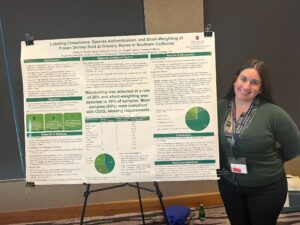
McKenna Rivers, 2nd place winner, Chapman University
“Optimization of DNA-based Methods for the Detection of Canned Tuna Species”
Third-place winner Aubrey Emmi titled her project, “Optimization of DNA-based Methods for the Detection of Canned Tuna Species.” Her objective was to compare four different DNA extraction methods for use with canned tuna products and determine how the substance the tuna is packaged in (oil or water) affects DNA extraction. Using DNA extraction methods and PCR and DNA sequencing, Emmi concluded that the DNeasy and Mericon methods had the greatest sequencing success and that tuna packed in oil showed greater amplification success overall than tuna packed in water.
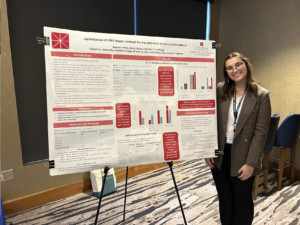
Aubrey Emmi, 3rd place winner, Chapman University
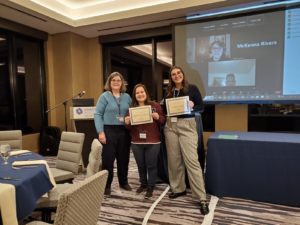
Lisa Weddig, VP of Regulatory and Technical Affairs at NFI (left), Dayne Darlen Lezame-Balderrama, 1st place poster presentation winner (middle), and Aubrey Emmi, 3rd place poster presentation winner (right)
For more information on the event, visit http://pftfish.net/2023/programBook.pdf
Recent Comments